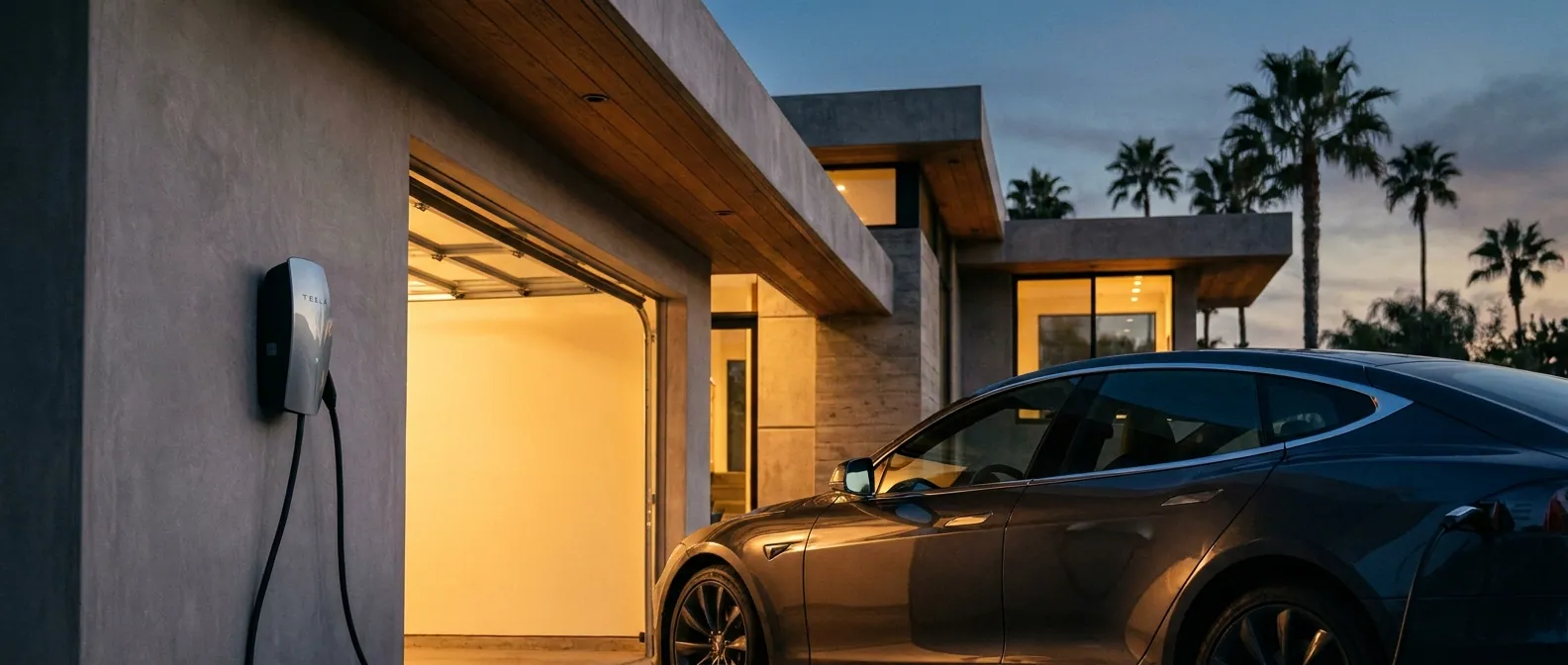
Why property owners are adding EV charging
Three things are driving multi-family EV charging right now in California. First, tenant demand: EV ownership in California crosses 25% of new vehicle sales, and apartment-dwelling EV owners need to charge somewhere. Second, California Energy Commission rebate programs (CALeVIP, EV Charge Network, utility-specific Charge Ready programs from SCE, PG&E, SDG&E) cover a substantial portion of installation cost for qualified projects. Third, mandatory EV-ready building codes for new construction and major renovations.
What you actually install
Multi-family installations are usually networked Level 2 chargers on shared infrastructure. The networking matters: it enables load management, usage tracking, and tenant billing without manual meter reading.
Common configurations: 6 to 12 chargers per garage or surface lot, fed from a dedicated panel sized for the total load, with load-managed software that throttles individual chargers when the building approaches its overall load limit.
Load management is the key
A naive multi-family install runs every charger at full draw simultaneously. That requires a panel that can handle 50A per charger times the count of chargers, which often means a full service upgrade. The cost gets prohibitive fast.
Load management software solves this. The system monitors total building load and throttles individual chargers when demand peaks. The result: 10 chargers can share an 80A or 100A circuit because they rarely all draw full power at the same time, and overnight load gets distributed across the fleet so every car still wakes up charged.
Billing models
Four common billing models for multi-family EV charging:
Tenant-pays-direct: chargers bill the tenant directly through a network app (ChargePoint, Wallbox, Enel X). Property owner gets a clean separation; tenant pays kWh + session fee.
Bundled into rent: charger access is a tenant amenity included in rent. Simplest model but the property owner absorbs the electricity cost.
Submeter rebill: chargers are submetered and the property owner rebills based on actual kWh. Requires utility-approved submetering and a billing system.
Hybrid: free charging up to a threshold, paid above. Common for keeping the perk while controlling power-user cost.
Permits and rebates
Multi-family projects in California typically require an electrical permit, a planning review (especially in jurisdictions with EV-ready requirements), and sometimes a Cal-Green review. The permit timeline varies wildly by jurisdiction.
Rebate programs that stack on most multi-family installs: SCE Charge Ready Multi-Family, SDG&E Power Your Drive, PG&E EV Charge Network, CALeVIP for disadvantaged communities, and the federal Section 30C credit for installs in qualifying census tracts.
What a project timeline looks like
Discovery and scope: 1 to 2 weeks. Site walk, electrical assessment, rebate-eligibility check, billing-model decision.
Design and rebate intake: 2 to 4 weeks. Engineered drawings if the load requires service upgrade, rebate applications filed.
Permit review: 2 to 8 weeks depending on jurisdiction.
Install: 1 to 3 weeks on site for 6 to 12 chargers, depending on conduit runs and panel work.
Inspection and commissioning: 1 to 2 weeks.
Wrapping up
Multi-family EV charging is one of the highest-ROI electrical projects for California property owners right now between tenant demand and stackable rebate programs. See our commercial electrical services or request a commercial bid.